[et_pb_section admin_label=”section”]
[et_pb_row admin_label=”row”]
[et_pb_column type=”4_4″][et_pb_text admin_label=”Text”]
Exploring the Foundations of Natural Balance and Health
Traditional Chinese Medicine (TCM) offers a profound approach to understanding the human body and its connection to the universe. At its core is the Five Elements Theory, also known as the Wu Xing, which provides a comprehensive framework for diagnosis and treatment. But what exactly is this theory, and how does it influence TCM practices today?
Let’s break it down.
What Are the Five Elements?
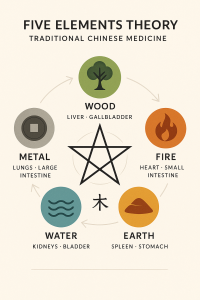
The Five Elements—Wood, Fire, Earth, Metal, and Water—represent fundamental forces and phases of change in nature and the human body. Each element is associated with specific organs, emotions, seasons, colors, and even flavors in Traditional Chinese Medicine.
-
Wood: Linked to the liver and gallbladder, spring, green, sour flavor, and the emotion of anger.
-
Fire: Represents the heart and small intestine, summer, red, bitter flavor, and joy.
-
Earth: Governs the spleen and stomach, late summer, yellow, sweet flavor, and worry or pensiveness.
-
Metal: Associated with the lungs and large intestine, autumn, white, pungent flavor, and grief.
-
Water: Reflects the kidneys and bladder, winter, black or dark blue, salty flavor, and fear.
The Dynamic Interactions of the Five Elements
InTraditional Chinese Medicine, the Five Elements don’t exist in isolation. They interact dynamically, creating balance or disharmony.
-
Generating Cycle (Sheng): Each element nourishes the next—Wood feeds Fire, Fire creates Earth (ash), Earth bears Metal, Metal enriches Water, and Water nourishes Wood.
-
Controlling Cycle (Ke): Elements regulate each other to maintain balance—Wood controls Earth, Earth controls Water, Water controls Fire, Fire controls Metal, Metal controls Wood.
These relationships explain how imbalances can lead to physical or emotional symptoms. For example, an overactive Wood element (liver) might overpower Earth (spleen), causing digestive issues like bloating or diarrhea.
The Five Elements and Diagnosis in TCM
Understanding the Five Elements is crucial in TCM diagnosis. Practitioners observe pulse quality, tongue color and coating, emotional state, and physical symptoms to determine elemental imbalances.
-
Wood excess might show as tension, headaches, or irritability.
-
Fire excess could manifest as insomnia, rapid heartbeat, or anxiety.
-
Earth deficiency may present with fatigue, loose stools, or sugar cravings.
-
Metal deficiency could show up as shortness of breath, dry skin, or chronic sadness.
-
Water imbalance might cause lower back pain, urinary issues, or fearfulness.
Treatment Strategies Using the Five Elements Theory
In TCM, treatment aims to restore balance by nourishing weakened elements or controlling excess elements. Techniques include:
-
Acupuncture to stimulate specific meridian points associated with the affected element.
-
Herbal medicine tailored to strengthen or regulate elements.
-
Dietary recommendations focusing on flavors, colors, and seasonal foods that correspond to the elements.
-
Qigong and Tai Chi to harmonize energy flow and support balance.
Modern Applications of the Five Elements
While the Five Elements Theory is rooted in ancient philosophy, its principles are relevant today. Many acupuncture clinics, wellness centers, and holistic practitioners incorporate this theory to create personalized treatment plans.
Patients often experience improved digestion, emotional resilience, better sleep, and enhanced energy by addressing elemental imbalances. It’s an elegant, time-tested system that connects mind, body, and environment.
Final Thoughts: Embrace Balance with the Five Elements
Understanding the Five Elements Theory in Traditional Chinese Medicine empowers individuals to take a proactive role in their health. Whether you’re seeking relief from chronic symptoms, managing emotional well-being, or simply looking to stay in harmony with the seasons, the Five Elements offer a roadmap to balance and vitality.
Discover how Traditional Chinese Medicine can transform your approach to wellness and help you achieve lasting harmony.
[/et_pb_text][/et_pb_column]
[/et_pb_row]
[/et_pb_section]