
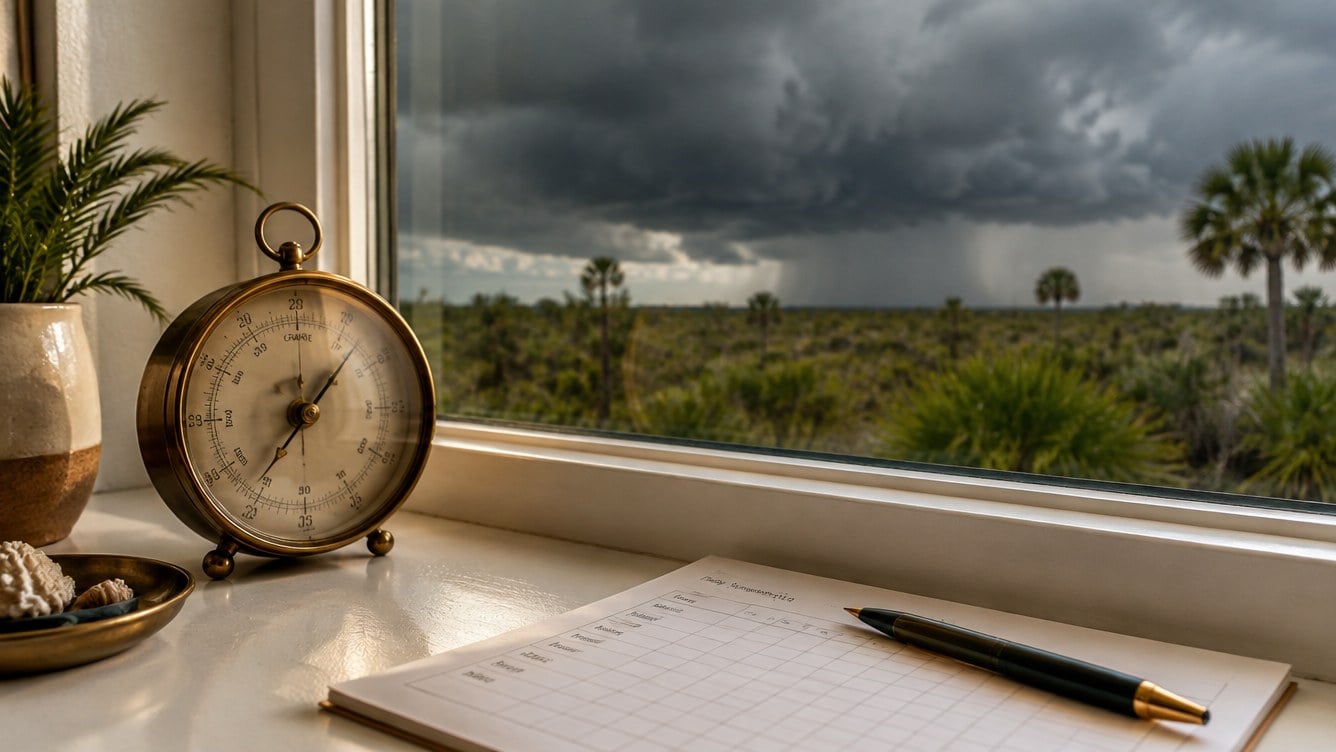
Every September the same conversation happens at the front desk of AcuMedGroup in Kissimmee. A patient with a ten-year-old knee, or a migraine history, or a back that was fine in April, says the pain “knew the storm was coming.” Then they ask whether that is real or whether they are imagining it.
The honest answer is that the research is mixed, the effect where it exists is modest, and it is strikingly individual. That is not a reason to dismiss the question. It is a reason to answer it for yourself with a log, and then to do something most pain patients never do: schedule treatment around the calendar instead of waiting for the flare.
The calendar in Central Florida is not subtle. The National Hurricane Center’s climatology page puts the Atlantic season at June 1 to November 30, with the peak on September 10 and “most activity occurring between mid-August and mid-October.” An average season brings 14 named storms and 7 hurricanes. Even in a year when none of them make landfall here, the pressure swings, the humidity and the daily thunderstorm cycle arrive on schedule.
What the research actually says about weather and pain
The big smartphone study: real, small, and mostly about humidity. The largest attempt to settle the question was a UK citizen-science project called Cloudy with a Chance of Pain, published in npj Digital Medicine in 2019. Researchers analyzed daily pain reports from 2,658 people with long-term pain against the local weather. Higher relative humidity raised the odds of a pain event (odds ratio 1.139 per 10-percentage-point increase). Lower pressure raised it slightly (odds ratio 0.962 per 10-millibar increase, meaning a drop in pressure went with more pain). Wind speed had a small effect. Temperature, once the others were accounted for, had none. The authors’ own summary: “the ‘worst’ combination of weather variables would increase the odds of a pain event by just over 20% compared to an average day.”
Twenty percent is not nothing, and it is not a hurricane. The study was unblinded, self-reported, UK-based and prone to the selection bias of people who already believed in the link. Its authors say all of this.
The follow-up: most people are not weather-sensitive, and the ones who are differ. A 2022 reanalysis in Pain Reports of 6,213 participants from the same project asked a sharper question: how many individuals actually show a weather effect? The answer was “1 in 10 patients with chronic pain were sensitive to the temperature, 1 in 25 to relative humidity, 1 in 50 to pressure, and 3 in 100 to wind speed.” And among the sensitive minority, the direction differed: some hurt more when pressure fell, some when it rose. That heterogeneity is the single most useful finding in the whole literature, because it means population averages will never tell you what your knee does.
The 2024 meta-analysis: for most joints, nothing. The strongest study design for a transient exposure is the case-crossover, in which each person is compared with themselves on flare days versus ordinary days. A 2024 systematic review in Seminars in Arthritis and Rheumatism pooled 11 such studies with 15,315 participants and found no association between humidity, air pressure, temperature or precipitation and the risk of rheumatoid arthritis flares, knee pain or low back pain. The one exception was gout, where “high temperatures combined with low humidity were associated with increased pain, redness, and joint swelling.” The authors’ conclusion is blunt: weather changes “do not seem to be risk factors for rheumatoid arthritis, knee, hip, or low back pain.”
The osteoarthritis review that disagrees. A 2023 meta-analysis in Annals of Medicine looked at 14 observational studies of 2,102 osteoarthritis patients and found barometric pressure moderately correlated with pain (summary r = 0.35) and temperature negatively correlated (r = -0.36), with humidity barely registering. Thirteen of 14 studies pointed the same way. But these were correlational studies, not case-crossovers, and the populations were mostly elderly. When two reviews a year apart reach different conclusions with different methods, the right reading is not that one is wrong. It is that the effect is small enough to appear or vanish depending on how you look.
Migraine is a different story. Headache research is where pressure holds up best. A 2015 SpringerPlus study followed 34 migraine patients through a Japanese typhoon and found attacks clustered when pressure fell 6 to 10 hectopascals below the 1013 baseline; roughly three quarters of migraine patients had weather-related attacks compared with about one in five tension-headache controls. Small study, one storm. A far larger 2023 study in Headache analyzed 4,375 users of a headache app and 336,951 hourly headache events over a year and found that “lower barometric pressure” and “a significant decrease in barometric pressure 6 h before” were both associated with more headaches, along with higher humidity and rainfall. Retrospective, app-based, but the six-hour lead time is a detail worth keeping.
Put the five studies side by side and a pattern emerges:
| Condition | Weather signal in the literature | Confidence |
|---|---|---|
| Migraine and headache | Falling pressure, especially in the hours before a front | Moderate, consistent across studies |
| Osteoarthritis | Pressure and cold in correlational studies; nothing in case-crossover studies | Low, mixed |
| Rheumatoid arthritis, low back, knee, hip | No association in the best-designed pooled analysis | Low for an effect |
| Gout | Heat plus low humidity | Moderate |
| Chronic pain in general | About one in fifty sensitive to pressure; direction varies by person | Individual |
Why Central Florida’s storm season is still a plausible trigger window
If the population evidence is this thin for joints, why treat storm season as a window at all? Three reasons, none of them mystical.
Pressure moves more, and faster, from August to October. Tropical systems and the daily sea-breeze thunderstorms that build every afternoon produce sharper pressure swings than the flat high-pressure days of winter. If you are in the one-in-fifty who is pressure-sensitive, or the larger group whose migraines follow a front, this is when the exposure is concentrated. The Headache study’s six-hour lead time maps onto the afternoon build-up almost exactly.
Humidity is the strongest signal in the largest study, and this is the wettest stretch of the year. Central Florida humidity is high year-round, but the late-summer combination of heat and saturation is the one the Cloudy with a Chance of Pain data flagged.
Behavior changes, and behavior drives pain. People move less when it storms every afternoon. Sleep suffers with heat and with the stress of watching a cone forecast. Sitting more, walking less and sleeping worse are each better-established pain amplifiers than any weather variable, and they all peak in the same eight weeks. Our anxiety, sleep and stress page explains why a nervous system on alert lowers the pain threshold; a hurricane watch is a textbook case.
So the honest framing is not “the barometer causes your pain.” It is “this window stacks several small pressures at once, and your body has its own answer to it.”
How to keep a symptom-weather log that answers your question
You do not need an app, though several exist. You need six weeks of consistent entries and a willingness to read them without deciding the answer first.
Each evening, record:
- Pain score, 0 to 10, for your primary complaint, and a second score if you have two (say, knee and head).
- Function: one number you can repeat, such as minutes walked, stairs climbed or hours sat comfortably.
- Sleep the previous night, in hours and a one-word quality rating.
- Medication or treatment that day.
- Weather: the day’s high, the humidity at mid-afternoon, and the pressure trend (rising, steady or falling). Any weather site or a cheap barometer will give you this. Note whether a storm came through and what time.
- Anything unusual: a long drive, a bad night, a missed workout.
After six weeks, look for three things:
- Do your worst days cluster in the 6 to 24 hours before a pressure drop, or on the days with the highest humidity? That is a weather pattern.
- Do your worst days follow your worst sleep or your least movement regardless of weather? That is a behavior pattern, and it is more fixable.
- Is there no pattern at all? That is also an answer. Roughly nine in ten people in the reanalysis were not weather-sensitive, and finding that out frees you to stop watching the sky.
Bring the log to your first visit. It changes the treatment plan more than any imaging does.
Timing a treatment plan around the window
Here is where the clinical logic of “treat the calendar” pays off. Every modality we use at AcuMedGroup works better as a course than as a rescue, and a course can be scheduled.
Acupuncture, started before the peak. Acupuncture works locally by releasing guarded muscle and fascia around a painful joint and centrally by engaging the brainstem’s own pain inhibition. The central effect builds over repeated sessions; that is why the trials run weekly courses. For a patient whose log shows a late-August to mid-October pattern, we start weekly visits in late July and taper to maintenance as the season winds down. For migraine specifically, the National Center for Complementary and Integrative Health summarizes the evidence as moderate for reducing migraine frequency, with fewer side effects than preventive drugs and a small advantage over sham; our headache and migraine post explains how we structure a preventive course.
Electroacupuncture for the joints that flare hardest. When a knee or a low back has a predictable bad month, electroacupuncture adds a low-frequency current to the needles to drive a stronger endorphin response than needling alone. We use it in the two to three weeks straddling a patient’s known peak.
Cupping and medical massage for the guarding. Storm-season pain is often muscle guarding around an old injury rather than the injury itself. Cupping decompresses the fascia; medical massage restores the range of motion that a week of sitting out thunderstorms takes away. Our sports medicine post covers how we sequence the two after an injury, and the same sequence applies to a seasonal flare.
Injections for the joint that will not settle. For a single joint that flares every season despite the above, our homeopathic pain injections are a non-cortisone option we time to land a week or two before the patient’s usual peak rather than after it.
A sample calendar for a patient whose log shows a mid-September peak:
- Late July: first visit, log reviewed, weekly acupuncture begins.
- Mid-August: electroacupuncture added for the primary joint; medical massage every other week.
- First week of September: injection if indicated; visits stay weekly through mid-October.
- Late October: taper to every two to three weeks; keep the log.
- December: review the log against the season, adjust next year’s start date.
Same building, same founder
Dr. Cecilia Rusnak PhD, LME, DAc, a Licensed Medical Esthetician and Florida-licensed Acupuncture Physician with 32 years of clinical experience, performs the treatments here and at our sister clinic, Healing Skin Medical Aesthetics, which shares our Kissimmee building and offers its own massage therapy for patients whose needs are relaxation rather than rehabilitation. And because storm season is still sun season in Florida, her SPF 40 sunscreen belongs in the same bag as your symptom log.
Frequently asked questions
Is it true that joints can predict the weather?+
Why does my headache start before the storm arrives?+
How long should I keep a symptom-weather log before it means anything?+
When should I start treatment if my pain peaks in September?+
Does the evidence say acupuncture prevents weather-related flares?+
Request an appointment
If your log, or your memory, says the same six weeks hurt every year, stop treating the flare and start treating the calendar. Request an appointment with AcuMedGroup in Kissimmee, bring whatever notes you have, and we will build a course that is in place before the pressure drops.